Getting Started
Getting started...
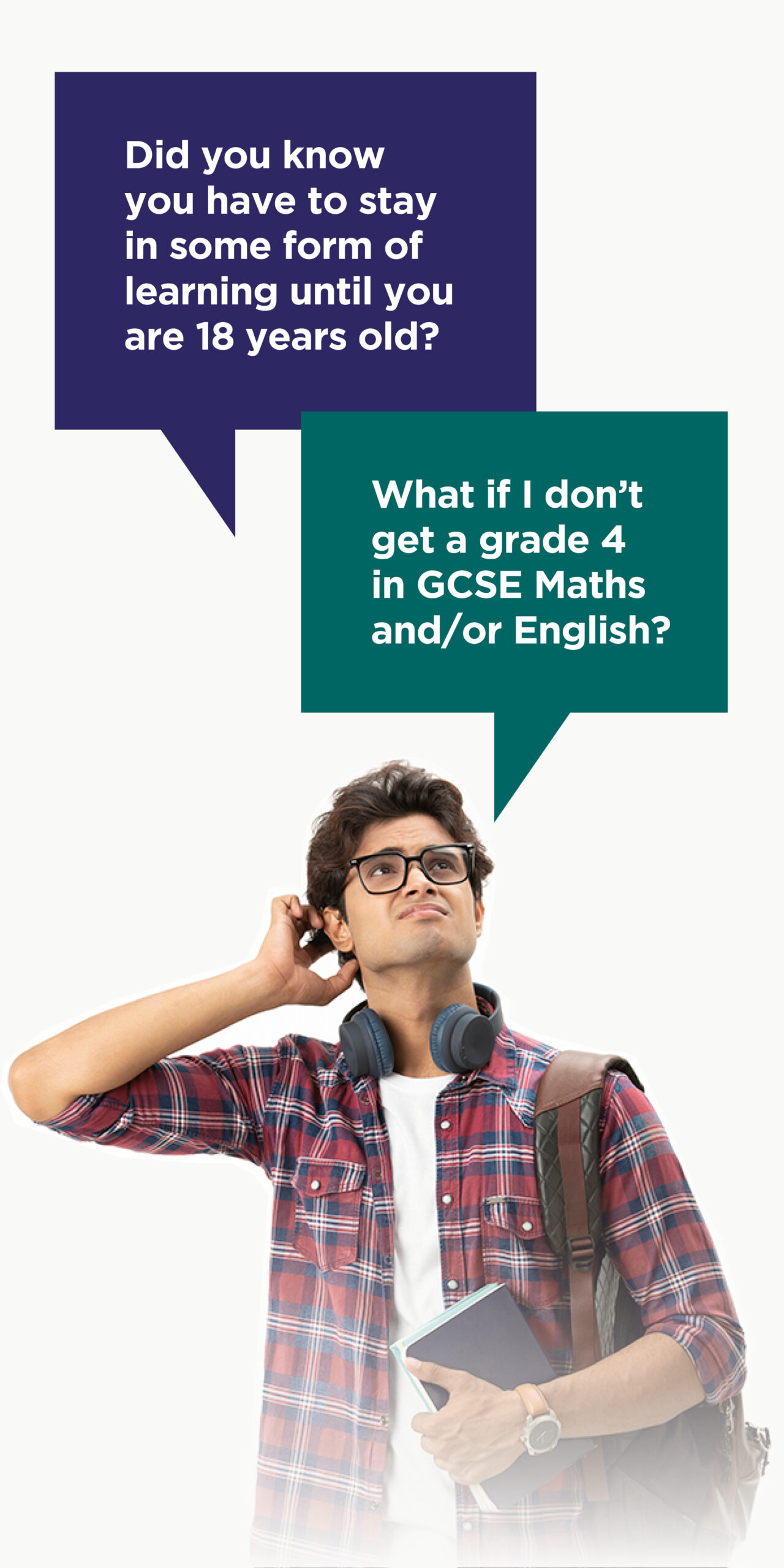
Did you know you have to stay in some form of learning until you are 18 years old?
- You can carry on studying at a school, college or be educated at home.
- You can earn money and learn at the same time, for example by doing an apprenticeship.
- You can study part-time, while you work volunteer (for 20+ hours a week).
What if I don’t get a grade 4 in GCSE Maths and/or English?
- You will need to retake these until you achieve a grade 4 (also known as a Level 2) by the time you are 18.
- You can find out more about this from your school, college or training organisation.
Choosing what to study and where to go
Regardless of your academic achievement level, there are a wide range of course options available to you. Download the table below to work out what you could do after Year 11.
Your education and what to consider
School 6th Form
000000000000000
Year 12 to 13 (Year 14 in some schools).
000000000000000
Learning and timetabling is more flexible than Year 7 to 11, but you will be expected to study independently during your free periods.
000000000000000
You can usually wear your own clothes, but there may be specific instructions, such as business wear only.
000000000000000
Although A Levels and vocational courses (courses directly related to career areas) are on offer, schools more commonly offer more A Level subjects.
6th Form College
000000000000000
6th Form College for 16 to 19-year-olds. You can wear your own clothes.
000000000000000
College campuses are often larger than school sites.
000000000000000
Learning and timetabling are more flexible than in school, but you will be expected to study independently during your free periods.
000000000000000
A Levels and vocational courses are on offer.
Further Education (FE) College
000000000000000
For people aged 16+. You can wear your own clothes.
000000000000000
College campuses are often considerably larger than school sites. A larger campus means more people.
000000000000000
Learning and timetabling are more flexible than in school, but you will be expected to study independently during your free periods.
000000000000000
A wide range of courses e.g. A Levels, BTECs, apprenticeships, ESOL, skills for working life etc.
Independent Special Schools and Colleges
000000000000000
For 16 to 25-year- olds with additional learning and physical needs.
000000000000000
Learning is based on your needs and may require you to go to a school out of the borough.
000000000000000
You can wear your own clothes.
000000000000000
You and your family will be working with a professional who will be helping you to plan your next step.
Apprenticeship providers / Training centres
000000000000000
For people aged 16+.
000000000000000
Learning and timetabling are more flexible and there is a real focus on getting you ready for the world of work.
000000000000000
You can wear your own clothes.
000000000000000
The courses and training are focused on ensuring you are ready to start a job.
So what pathways are available to you?
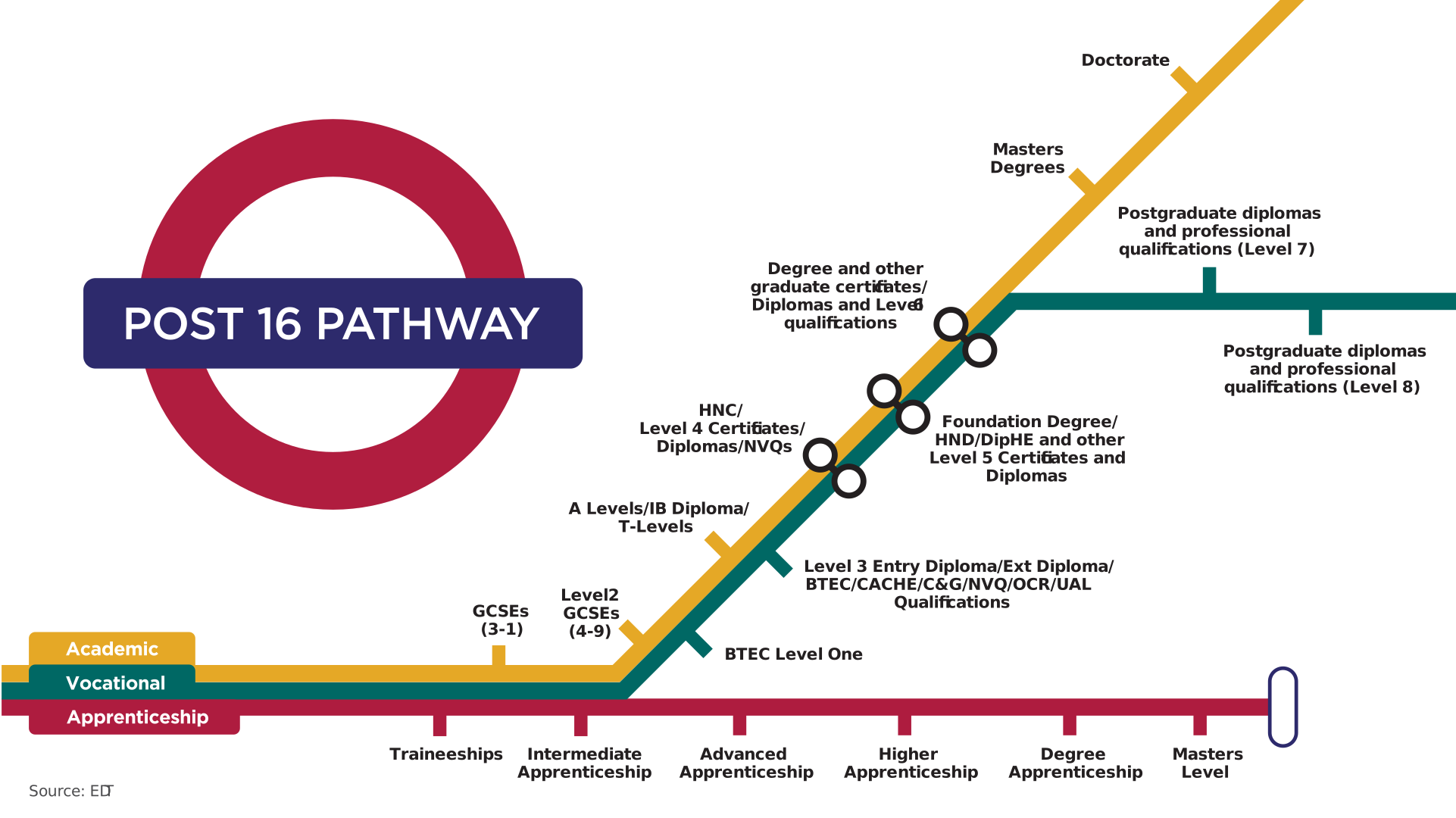
In Year 11 (or Year 12, if you are doing a one-year course), you will have to make some big decisions about your future. Your main options are following either an academic, vocational or industry led pathway.
All young people in Year 11 must continue in education or training until at least their 18th birthday (although, in practice, the vast majority of young people continue until the end of the academic year in which they turn 18). You will have many options including: continuing at school; going to college; getting an apprenticeship or traineeship; or even starting your own business.
To make your choice, you need to think about yourself and consider what you are interested in. What are you good at? What do you enjoy? What are your favourite subjects at school? What are your current career ideas?
You then need to find out about the opportunities out there, the different routes you can take, and how and when to apply.
The pathways explained
Vocational
Entry level 1, 2 and 3
Entry level courses help students to improve their reading, writing and IT skills and boost students’ knowledge and confidence. These qualifications will prepare you to take your next step whether that is a traineeship, apprenticeship, a college course, supported employment or independent living.
Levels 1, 2 and 3
Vocational or work-related courses train you for specific jobs, such as catering, hairdressing, carpentry, bricklaying, motor mechanics and childcare. During a vocational course, you will be assessed on your practical skills and your ability to do the job. These courses can often be studied part-time as part of an apprenticeship.
BTEC courses
BTEC courses are work related qualifications combining theory with practical learning. They are ideal for students who are interested in a vocational area, such as health and social care, travel and tourism, engineering, sport, business, art and design, performing arts, and public services.
Academic Courses
Level 3 courses
The most common academic qualifications are A Levels. With A Levels, most students study three (or maybe four) subjects. There are more than 40 different A Level subjects available and the range will depend on the school or college you attend. At some schools and colleges, you can study a mix of A Levels and BTEC Level 3 qualifications.
IB Diploma
With the International Baccalaureate (IB) Diploma Programme, students choose six subjects, three at higher level and three standard level. They combine this with the Diploma Programme core, consisting of study and life skills, which is taken by every IB student.
T Levels
T Levels are a brand new qualification designed for 16 to 19-year-olds, with a mixture of classroom learning and work placements. They follow GCSEs and are equivalent to three A Levels. T Levels are a two-year qualification, after which you can step straight into your chosen career, an apprenticeship or a degree.
Apprenticeships
Levels of apprenticeship
There are different levels of apprenticeship. The level that you start at will be determined by your experience, qualifications and what is available locally.
Intermediate apprenticeships – there are no set requirements, but some GCSEs at grade 3 or above are expected. You will be employed,
earn a wage and gain a qualification.
Advanced apprenticeships – usually require four GCSEs grades 9-4. You will be employed, earn a wage and may gain a qualification.
Higher apprenticeships – require a Level 3 qualification, e.g. A Levels or BTEC. You will be employed, will earn a wage and may gain a qualification.
Degree apprenticeships – require a Level 3 qualification, e.g. A Levels or BTEC, and allow you to combine practical, workplace training with a university degree. They can lead to a Level 7 qualification, depending on the apprenticeship you are doing.